
The pumped hydroelectric storage system of Taccu sa Pruna
Share
The Taccu sa Pruna project
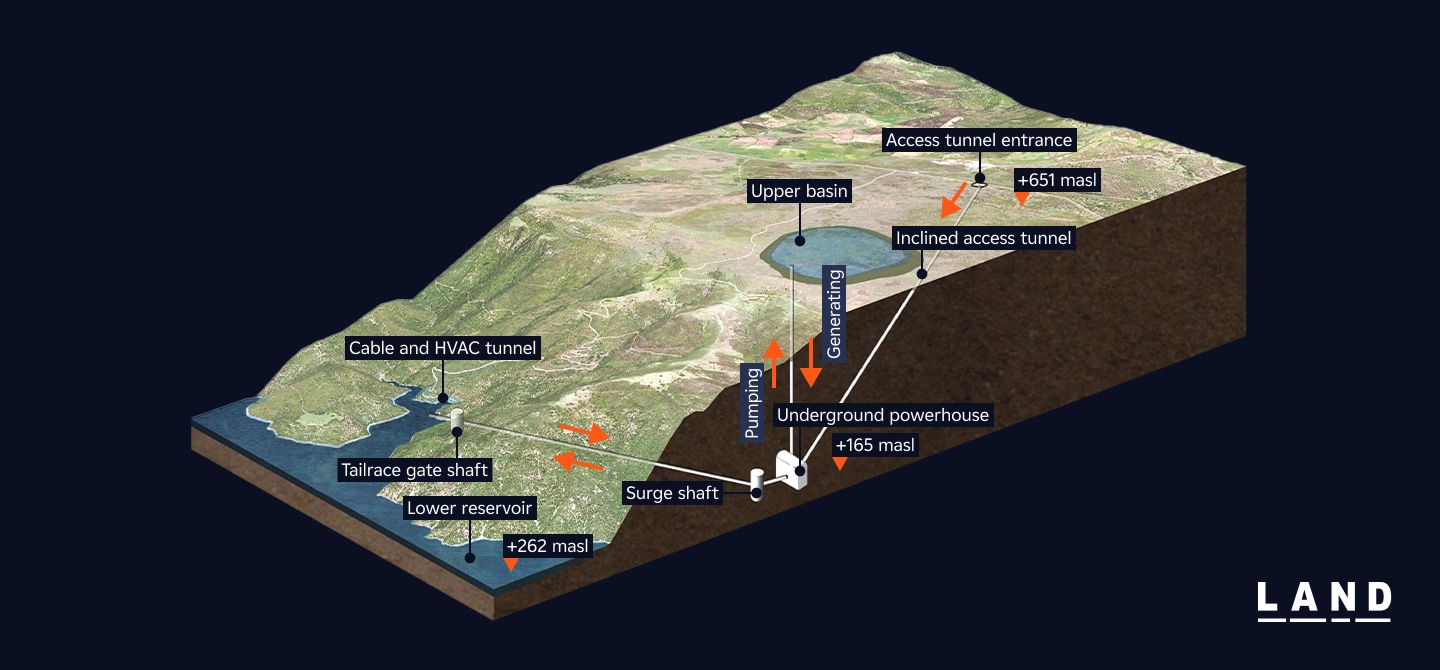
The pumped hydroelectric storage system of Taccu sa Pruna is developed in the territory of the municipality of Esterzili, in the Sud Sardegna province. The project foresees the construction of a new upper reservoir with a capacity of around 3 million m³ and an underground waterway system that connects it to the existing reservoir of Nuraghe Arrubiu. The plant operates as a closed cycle with a zero net water consumption. It will employ only around 1% of the water volume that can be stored in the Nuraghe Arrubiu reservoir and will completely return it after one cycle. The project also includes the construction of an underground powerhouse, which will host the machines.
The Taccu sa Pruna plant represents a strategic initiative for the decarbonisation and the strenghtening of the competitiveness of the Italian and European power systems. In light of its relevance, the project was included by the European Commission in the second Union's list of energy Projects of Common Interest (PCI code 1.29), which identifies the energy infrastructure projects of utmost priority for the European Union.
The Taccu sa Pruna plant represents a strategic initiative for the decarbonisation and the strenghtening of the competitiveness of the Italian and European power systems. In light of its relevance, the project was included by the European Commission in the second Union's list of energy Projects of Common Interest (PCI code 1.29), which identifies the energy infrastructure projects of utmost priority for the European Union.
Pumped hydroelectric systems
The Italian Integrated National Energy and Climate Plan (also called PNIEC) recognizes a fundamental role for pumped hydroelectric storage systems in the achievement of decarbonization goals. In fact, these systems guarantee the flexibility and the security of the power network and play an essential role in the efficient integration of non-programmable renewable energy sources (RES) in the national energy system. In this scenario, Edison has decided to strengthen its commitment to the energy transition, including the development of pumped hydroelectric storage in its strategic Plan towards 2030. In particular, Edison’s development plan foresees the construction of “pumped-storage-only” systems in which water retrieved from the lower reservoir and stored in the upper reservoir is entirely returned to the former, without any net consumption of water.
Last update: 15 January 2026