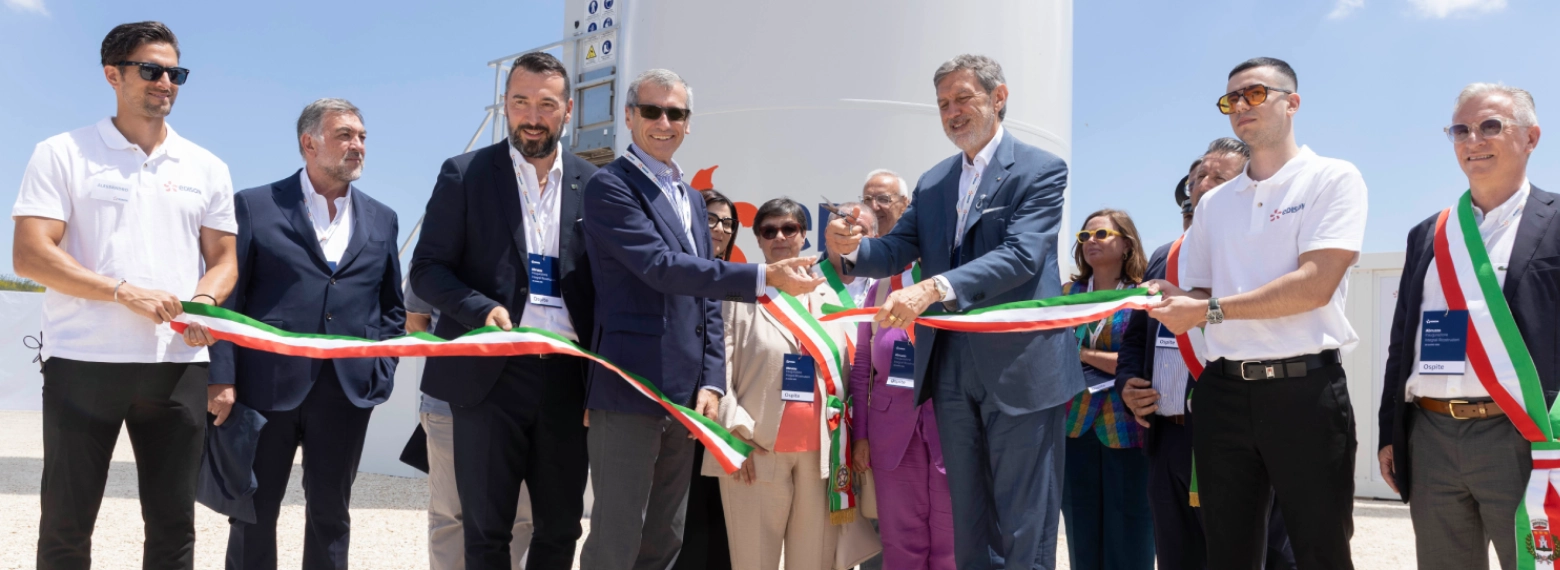
Milan, June 26, 2026 – Edison marks a significant milestone in Italy's energy transition with the completion of the comprehensive reconstruction and recommissioning of its entire wind portfolio in Abruzzo, reaching a total installed capacity of 186 MW. This technological renewal and expansion project took place in two phases – between 2019 and 2021 and subsequently between 2025 and 2026 – making the region a leading model for energy transition and sustainable development and resulting in a total investment of over 200 million euros.
With the completion of the work and the plants’ return to operation, Edison has increased its installed capacity in Abruzzo from the original 114 MW to the current 186 MW, while reducing the number of wind turbines on the mountain ridges by 73% (173 wind turbines were replaced with 47 latest-generation turbines) and achieving a 2.5-fold increase in renewable energy production to 355 GWh per year – enough to meet the energy needs of over 131,000 households, nearly equivalent to the entire province of Pescara – while preventing the emission of 148,000 tonnes of CO₂ during the year.
“The completion of the repowering program in Abruzzo marks a strategic milestone in Edison’s growth in renewable energy sources in Italy and in the Group’s contribution to increasing technological diversification and fostering an increasingly resilient and decarbonized national energy system” said Nicola Monti, Edison CEO. “Abruzzo is a key region for Edison, with which we have built a long-standing collaborative relationship over time, based on dialogue with institutions, local governments, and communities. Projects like this concretely demonstrate how the energy transition can combine technological innovation, environmental sustainability, and local economic development, enhancing existing sites and contributing to the growth of skills and industrial supply chains that are strategic for the country’s energy future”.
“We were pioneers in Italy in the comprehensive reconstruction of wind farms, embarking on this journey nearly ten years ago with a design approach that combines technological innovation, industrial expertise, and collaboration with the local community. Today, Abruzzo is the region where we have completed the largest comprehensive reconstruction project, renovating all our wind farms. This is an achievement of which we are particularly proud, and it demonstrates how it is possible to balance increased renewable energy production, a reduction in the number of turbines, and better integration into the landscape. It is a concrete model that contributes to the development of the local economy, and one that we intend to continue expanding to other Group facilities, starting with Campania,” comments Fabio Lamioni, Edison Rinnovabili CEO.
The potential of repowering for wind power growth in Italy is particularly significant. In fact, the plants slated for repowering account for nearly half of the country’s installed wind capacity: approximately 6 GW out of a total of 13.5 GW installed. Considering an average capacity increase of 124% in projects currently awaiting authorization, the modernization of existing plants alone could generate over 13 GW of new renewable capacity, potentially contributing about 60–70% of the new wind capacity needed to meet the target of the Integrated National Energy and Climate Plan (PNIEC), which calls for 26 GW of installed wind capacity by 2030.
Edison’s comprehensive reconstruction projects in Abruzzo have contributed to the development of the local supply chain and to the creation and consolidation of a specialized energy supply chain in the region, which employed a total of over 400 workers during the construction phase. This has triggered a virtuous cycle for employment and the local supply chain, driving the professionalization of local businesses. Small artisan businesses, thanks to the steady work provided by plant maintenance and construction sites, have in fact been able to establish themselves and expand. This is the case for local companies that began as small cooperatives and have now become limited liability companies (Srl) with dozens of employees, contributing to a supply chain that encompasses transportation, lodging, food service, gas stations, and auto repair shops.
The comprehensive reconstruction work has also made it possible to optimize existing production sites that are already operational and equipped with infrastructure, focusing increasingly on their integration with the environment and the landscape, thereby improving their visual appearance and harmony with the natural setting. This approach demonstrates how the energy transition also presents an opportunity to improve the relationship between infrastructure and the environment. The process was, in fact, accompanied by careful environmental restoration efforts: the sites of the dismantled wind turbines were covered with denaturalized soil – reusing excavated earth – and converted into grazing land for flocks of sheep. The slopes were smoothed out, and hydroseeding was carried out to recreate the original natural environment. In other cases, at the request of local authorities, the foundations were not specifically removed but were buried to provide secure bases for the installation of benches and tables for picnic areas. By leveraging the routes and construction work for the new power cable ducts, Edison has also actively collaborated on the redevelopment and enhancement of the “Sentiero del Vento”, an ancient mountain trail that has now been restored and transformed into a tourist route accessible to hikers and mountain bikers.
With 9 wind farms and 186 MW of installed capacity, Edison is now the leading wind power operator in Abruzzo, accounting for 61% of the region’s total wind power generation. Abruzzo is also the first region in Italy where Edison has completed the repowering of all its wind farms: a model that combines increased production capacity, technological innovation, reduced landscape impact, and efficient land use, and which demonstrates the strategic role of repowering in the development of Italy’s wind energy sector.
Today, Edison has approximately 8 GW of installed generating capacity, of which 2.3 GW comes from renewable sources (wind, hydroelectric, and solar). In 2025 alone, it generated 4.4 TWh of green energy, avoiding the emission of approximately 1.9 million tonnes of CO₂. The growth of renewables is one of the pillars of Edison’s decarbonization strategy: by 2030, the Group aims to reach 4 GW of installed renewable capacity, bringing green sources to account for approximately 40% of its electricity generation mix. At the same time, the goal is to reduce the emissions intensity of production to 200–210 gCO₂/kWh (in 2025, it stood at 278 gCO₂/kWh). This approach has already enabled Edison to reduce its direct CO₂ emissions (Scope 1) by more than 70% compared to 2006 levels, thanks to the gradual transformation of its generation mix and the increasing use of renewable sources.