Governance
Our corporate governance system
Edison has adopted a traditional organisational model, as set out in the bylaws, which provides for the distinction of roles and responsibilities between the board of directors and the control body, and consists of the following bodies: Shareholders' Meeting, Board of Directors (assisted by the Committees established within the Board itself), Board of Statutory Auditors, Audit Company and Supervisory Board under Legislative Decree 231. In addition to these bodies are the special meeting of savings share holders and the category representative.
Pursuant to current regulations, Edison maintains the status of "listed issuer" and, on a voluntary basis, adheres to the Corporate Governance Code (with limited and non-significant exceptions), even though Edison currently has only savings shares listed on the Euronext Milan Market (EXM).
Due to the listing of savings shares, Edison falls under the definition of a public interest entity and, in this context, of a parent company of a large group pursuant to Legislative Decree 125/2024: therefore, starting from the 2024 financial year, it is required to draw up the Consolidated Sustainability Report.
Pursuant to current regulations, Edison maintains the status of "listed issuer" and, on a voluntary basis, adheres to the Corporate Governance Code (with limited and non-significant exceptions), even though Edison currently has only savings shares listed on the Euronext Milan Market (EXM).
Due to the listing of savings shares, Edison falls under the definition of a public interest entity and, in this context, of a parent company of a large group pursuant to Legislative Decree 125/2024: therefore, starting from the 2024 financial year, it is required to draw up the Consolidated Sustainability Report.
Edison's corporate governance model
The governance of the corporate bodies is complemented by the management governance of Edison, organized into a series of Divisions, whose managers – reporting directly to the Chief Executive Officer – and whose responsibilities are defined by an Organizational Communications system issued by the Chief Executive Officer himself, in line with the Corporate Governance model adopted by Edison.
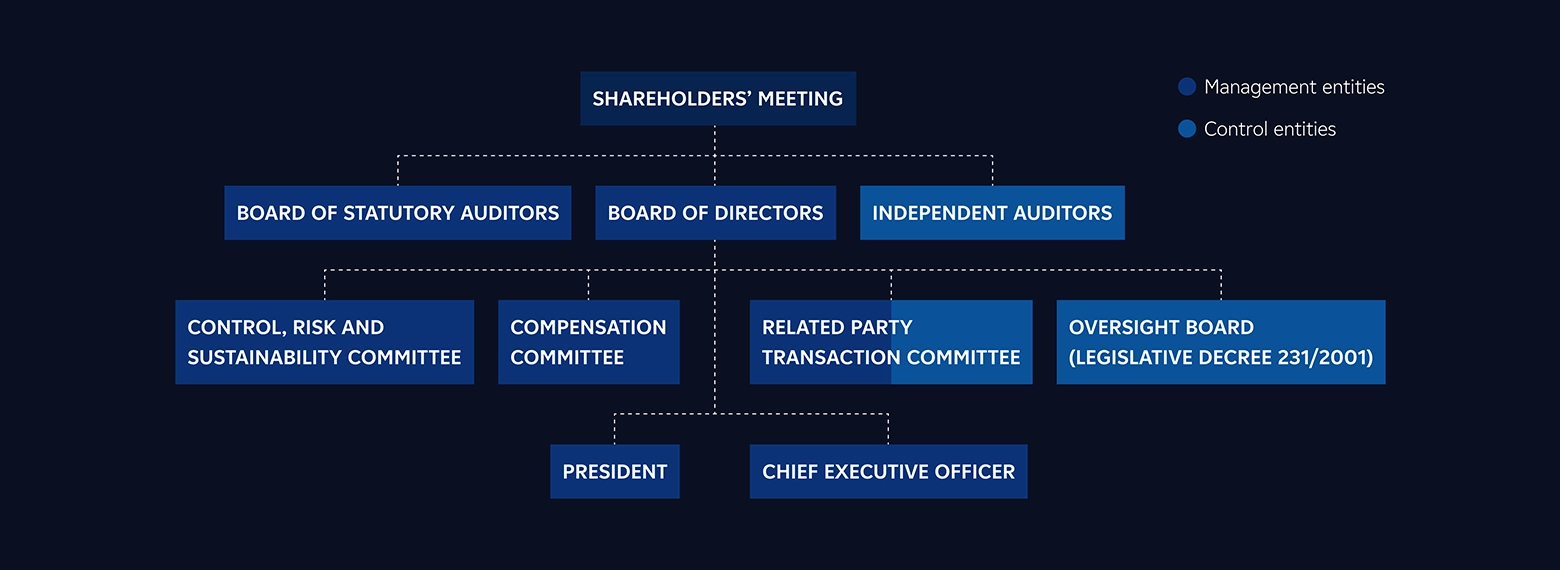

Management and control entities

Internal Control and Risk Management System

Remunerations

Other regulated informations

Extraordinary transactions
Useful resources
Management, sustainability and governance report 2024
3.78 MB Download